The AI Architecture That Scales a High-Value Consulting Practice
In the consulting sector, there is a rapid shift occurring, a technological arms race that is fundamentally altering how value is delivered. Over the last 90 days alone, we have seen major systemic updates across the leading AI models. Yet, the majority of independent consultants are still processing their meetings manually, or worse, using AI in a fragmented, high-risk manner.
Without a structured system, AI is simply another open browser tab draining your attention. With a system, it becomes a formidable leverage machine.
As an independent board advisor and programme management consultant, my focus is relentlessly on high-leverage outcomes. In this article, I will detail the precise AI architecture I use to run my consulting practice, ensuring maximum efficiency without compromising governance or quality.
The Operational Bottleneck
The traditional consulting delivery model is heavily reliant on manual cognitive labour. Diagnostic reports, stakeholder maps, meeting minutes, and strategic briefs take hours to synthesize and format.
Currently, many professionals attempt to solve this by pasting raw data into standard generative AI interfaces. This ad-hoc approach creates severe operational tension. Firstly, it leads to digital sprawl, a mess of disconnected outputs that lack structural coherence. Secondly, it introduces significant risk regarding data security and intellectual property protection. If you are handling sensitive transformation data for health or government sectors, a casual approach to AI integration is a profound compliance failure.
The systemic consequence is that consultants remain trapped in the delivery mechanics, unable to elevate their positioning to strategic advisory. They are working harder, not smarter, capped by the manual hours required to format their expertise.
The TTPO Framework
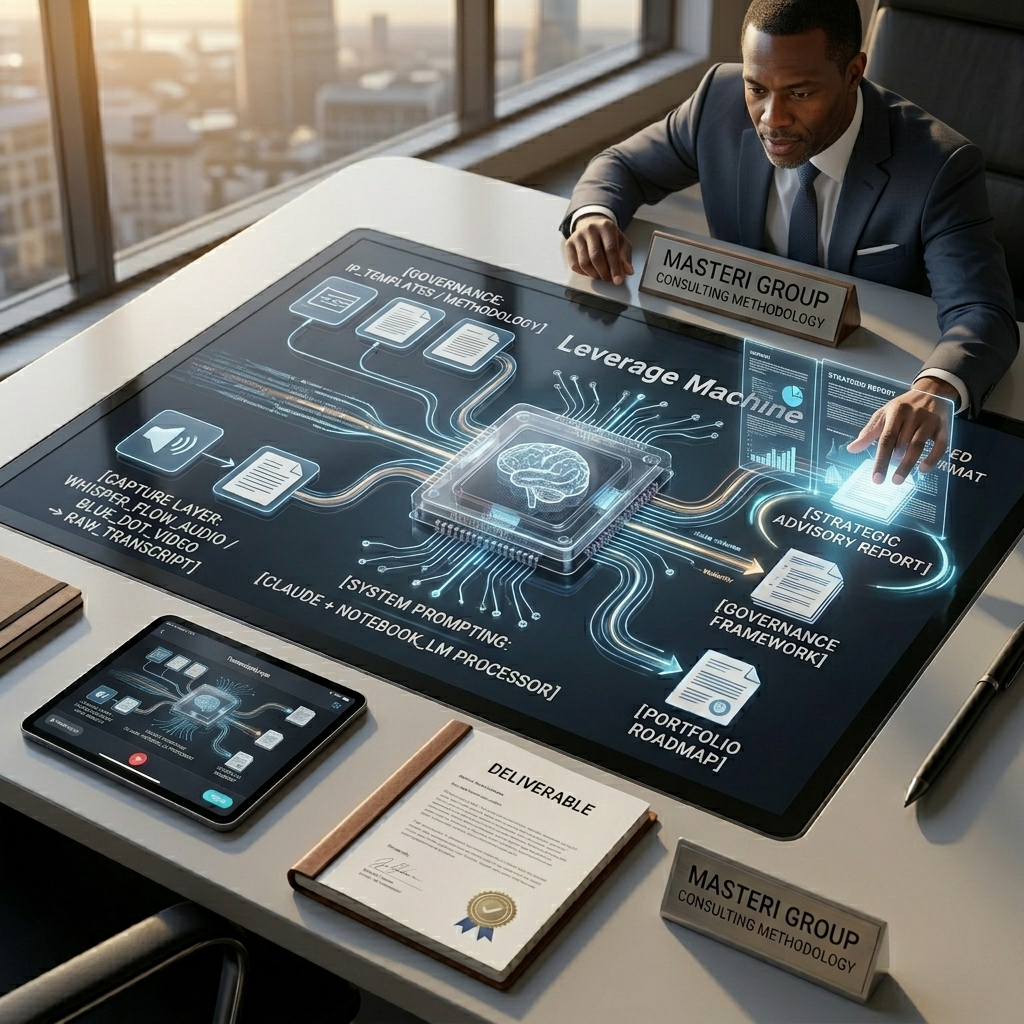
To run complex programmes of work that hold together under real-world pressure, you need a methodology that moves information seamlessly from purpose to action. I have found one formula to be unequivocally effective: Transcript + Template + Prompt = Output.
This pipeline mirrors the core principles of effective governance: clear structure, sensible systems, and shared information.
Transcript (The Raw Material): Information is captured exactly as it occurs. This could be an unstructured voice note outlining a strategy, or a fully transcribed risk committee meeting. The data is comprehensive and untainted by manual note-taking biases.
Template (The Structure): This is your codified intellectual property. Whether it is a project initiation document or a portfolio career roadmap, the template dictates the exact format, branding, and standard required for the final deliverable. These are templates you would have built along your journey as a professional housed in a project folder or Google notebook.
Prompt (The Instructions): A highly refined, context-heavy instruction set (often saved as an MD file or a ‘Skill’) that directs the AI to map the raw transcript accurately into the constraints of the template. If not a skill yet, it can be surfaced as one once you have created your desired output.
Output (The Draft): A near-final, highly structured document that requires only executive review and contextual nuance, rather than hours of formatting. The focus is more on the content as opposed to the structure and design.
Executing the Tech Stack
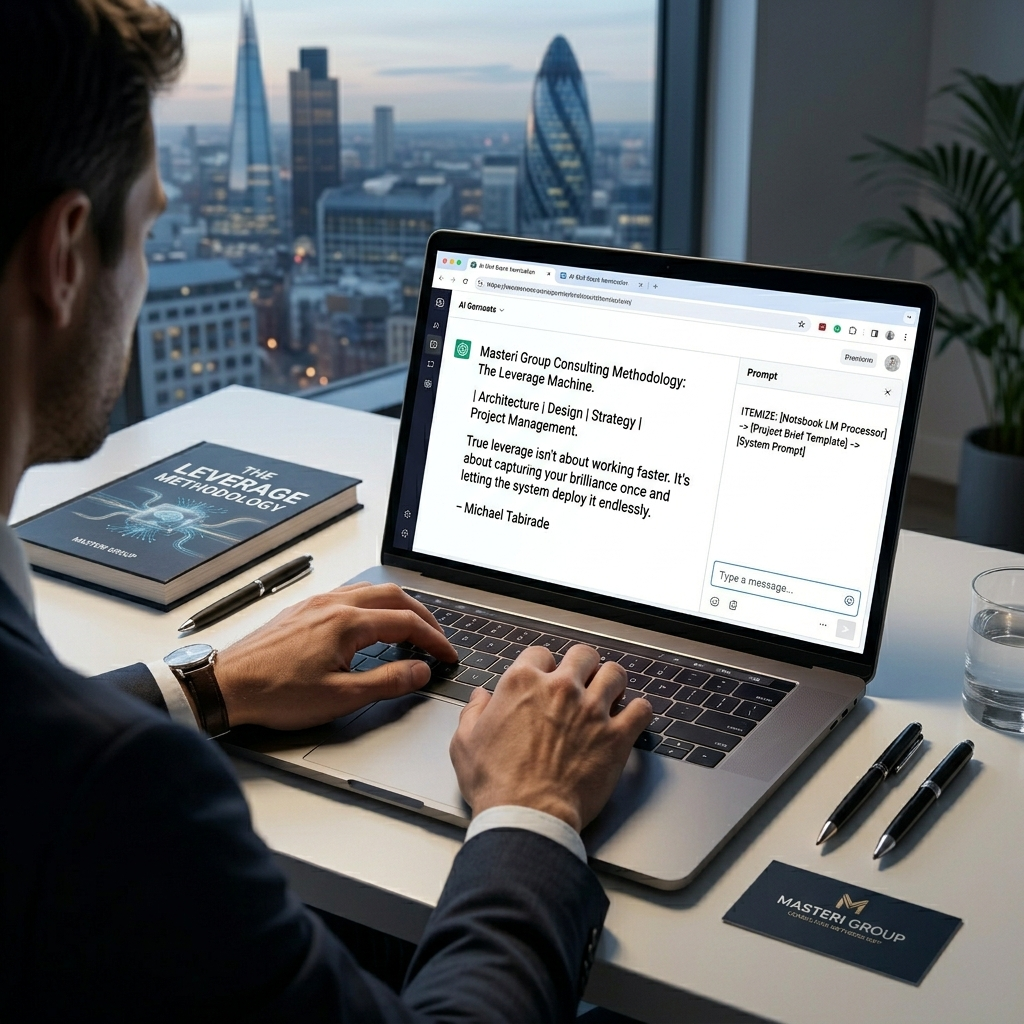
Building this architecture requires a deliberate integration of tools. Here is the operational setup:
1. The Capture Layer
Frictionless data entry is mandatory. I utilise Wispr Flow for immediate, high-fidelity voice-to-text when ideating or drafting communications. For client interactions, tools like Blue Dot are integrated to capture both the video and the transcript, providing a searchable, interactive archive of all decisions and actions (everyone is talking about Granola but BlueDot has been around for at least 2.5 years).
2. The Synthesis Layer
Raw data requires contextual processing. Notebook LM is exceptionally powerful for deep research and synthesis, especially when loaded with your own methodologies and past content. By connecting it to Claude via an MCP (Model Context Protocol), you create a closed-loop system where the AI draws exclusively from your verified, secure data repository to generate insights. Of course if your default system is Google you have a huge advantage.
3. The Integration Layer
A mature tech stack avoids fragmentation. I anchor my workflow in Google Workspace for robust storage, document creation, and native Gemini access, while maintaining Microsoft 365 alignment for public sector and enterprise client compatibility.
4. The Quality Assurance Layer
This is the most critical step. AI hallucinates. It produces generic “schlop” if left unchecked. You must remain the architect and project manager of this workflow. Your value lies in the final review, applying judgement, ensuring compliance, and injecting the strategic nuance that a machine cannot replicate.
The Strategic Imperative
The integration of these systems is not about merely doing the same tasks faster; it is about fundamentally changing the nature of your output.
When you itemise what was once second nature to you and code it into a series of repeatable prompts and templates, you separate your intellectual property from your time. You build a digital backbone that supports consulting delivery, content creation, and product sales simultaneously.
This requires a different level of human thinking. It forces you to stop being the operator within your business and start being the systems engineer of your business. The technology is merely the facilitator; the buck still stops with your expertise and your ability to govern the process.
Conclusion: Securing the Future
Your lived experience running complex programmes or leading teams is highly valuable. But until it is digitised, structured, and automated, it is not scalable.
Identify your core methodologies. Digitize them into templates. Lock them into a prompt workflow. That is how you build a practice that delivers high-trust outcomes and sustainable leverage.
What manual process in your delivery will you automate this week?