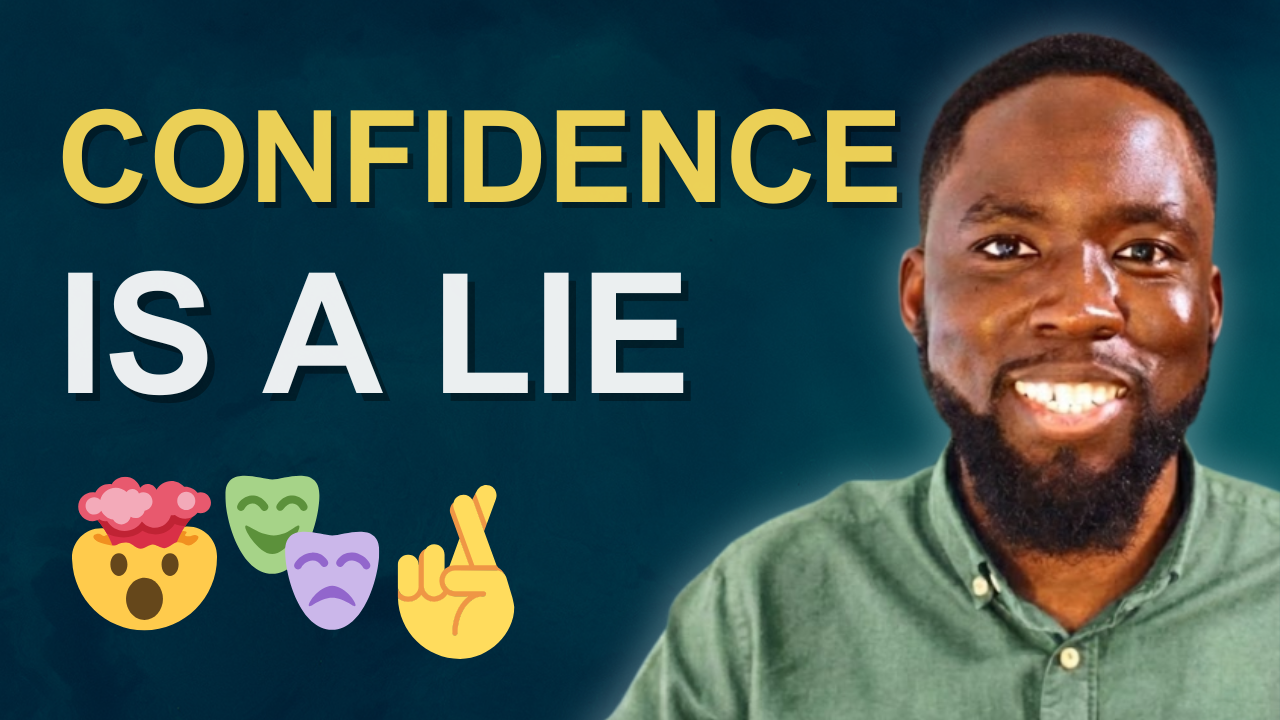
Confidence Isn’t Found. It’s Built
Introduction
Most professionals I speak to start the year with a high level of motivation. Which really means they want a high level of results. Results in their career. Results in their bank account. Results that allow them to finally feel like they are “ready”. Yet the reality is that intentions are strong, but actions get postponed. They imagine confidence is a starting point; that once they feel capable, they will finally execute on their ideas.
But confidence doesn’t arrive by accident. It is an outcome, not a prerequisite. Given the “social media of the world” and the crazy change happening around us, there is a pandemic of inaction. We see what others are doing, feel a sense of lack, and freeze.
In this article, I want to explore why confidence is something you must intentionally build through evidence, and why doing, not waiting, is what makes you ready.
Wanting Confidence Without Evidence
I’ve met exceptionally talented people who have wanted to do things in the past but haven’t. They have the desire. They have the potential. Yet beneath the surface, there is low self-efficacy and low self-esteem holding them back. Often, the response is hesitation disguised as logic. “I don’t feel confident yet.” “I need to learn more first.” “I’m waiting for the right time.”
But when pressed, these same people are usually suffering from the “18-day prophecy”, where motivation fades, and action stops after less than three weeks. One insight I gained from my recent 90-day YouTube challenge was that I didn’t need to be a master filmmaker to start; I needed to start to learn how to manoeuvre. The problem wasn’t a lack of ability. It was a lack of evidence.
Confidence Has a Cost, and a Logic
One of the most important insights I’ve learned is this: Confidence without evidence doesn’t create success; it creates delusion. We’re conditioned to believe we must feel ready before we act. That waiting is rational. That it keeps us safe. In reality, waiting feels logical but fails practically. Tony Robbins’ success cycle highlights the truth: Actions equal results, and results equal evidence. Confidence has a cost. Sometimes that cost is doing the work when you don’t feel like it. Sometimes it’s the 10,000 hours of repetition.
Sometimes it’s facing the “False Evidence Appearing Real” (F.E.A.R) that keeps you stagnant and choosing to “Face Everything And Rise”. The question isn’t whether confidence costs something; it’s whether you’ve consciously chosen to build the evidence required to sustain it. The professionals who thrive aren’t the most confident. They’re the most consistent.
Designing Confidence in Reality
Designing confidence starts with moving from theory to practice. Here’s what that looks like in practice:
Start with the insignificant.
Don’t overengineer the big goal. If you need to network, don’t worry about the meeting yet, just create the tracker.
Action creates evidence.
You can’t think your way into a new identity. You have to act your way there. Write the email, send the link, do the thing.
Value consistency over intensity .
You don’t have to be perfect. As James Clear says, if you miss one day, that’s fine, just don’t miss two days in a row.
Systemise your persistence.
Willpower fluctuates. You need systems that allow you to do the activity again and again, regardless of your mood.
Review through repetition.
Identity is forged through repetition. Doing something for 90-120 days creates the undeniable proof that “this is who I am”.
Structure doesn’t kill belief; it installs it.
Why This Matters Now
We’re living through an era where comparison is at an all-time high and self-efficacy is at an all-time low. The old model of “fake it ’til you make it” no longer holds, because you can’t fake the evidence required to reshape your identity. We feel judged by the polished lives of others, leading to a sense of lack rather than abundance. The argument could be that you don’t have the riches, the wealth, or the environment to start, but if anything, focusing on what you lack just reinforces the paralysis.
Confidence now belongs to those who think like practitioners, not perfectionists. Those who treat action like an experiment, not a final exam. Those who understand that competence equals confidence. This isn’t about being fearless. It’s about being evidence-based.
Conclusion
Confidence isn’t found in a pep talk or a motivational video. It’s created through small steps, repetitive action, and the accumulation of proof. The most empowered professionals aren’t the bravest; they’re the busiest doing the right things. So before chasing confidence, ask yourself:
What small, “insignificant” action can I take today to begin building the evidence I need?.
Understand. Reach. Expand.
Peace.