The Independent Consulting Frameworks that Consultants use to help B2B Clients
There comes a point where the corporate machine stops serving you, and going independent feels like the only logical next step. It is a thrilling prospect. Then a frustrating reality blocks your path. What exactly does a consultant do on a day-to-day basis? The answers you find online are usually vague and entirely unhelpful. In this article, I will walk you through a specific independent consulting framework that shapes every client conversation I have before a single proposal is written.

Why Your Value Gets Lost in Translation
Many professionals struggle to articulate what they bring to the table when trying to secure their first client. Industry definitions are far too broad. This vagueness kills your confidence and completely confuses potential buyers.
Organisations do not hire vague problem solvers. They bring in external help for very tangible reasons. They need an external perspective to see what they are missing, an expert to validate what they already suspect, or someone to simply take on and manage the risks and issues. Shifting risk is a massive driver for bringing in outside talent. If you cannot pinpoint which of these needs you fulfil, landing meaningful engagements becomes incredibly difficult.
The Two Modes of Client Work
Going independent gets much clearer once you understand that consulting splits into two distinct categories. You are either protecting what an organisation has, or you are growing what it could have.
Think of it like managing a football team. If you defend your position, you prevent goals from going in. Defensive consulting naturally focuses on risk management, governance, audits, and compliance. These actions ensure nothing bad happens and help leaders operate safely within regulatory boundaries.
Conversely, if you focus entirely on your attack, your goal is to score. Offensive consulting is all about strategy, growth, culture change, and creating brand new income streams. You are thinking creatively about what has never been done before to inform the future of the business.
You will naturally lean towards one of these modes based on your professional background. Organisations hire for one mode at a time. It is crucial to own your natural strengths instead of trying to be everything to everyone.
Building Your Specific Offer Using an Independent Consulting Framework
To build a flourishing portfolio career, you must turn these high-level concepts into a concrete offering. Within my independent consulting framework, I break the work down into eight distinct pillars.
- Culture focuses on organisational ethos and how specific behaviours produce measurable outputs.
- Management and leadership provide the necessary frameworks that ensure operational delivery actually happens.
- Governance establishes the decision-making guardrails that move the organisation towards its strategic aims safely.
- Risk management involves using assurance frameworks to manage and mitigate things that have not happened yet.
- Compliance and legal ensure you are operating safely within sector-specific regulatory obligations.
- Strategy defines the unique approach an organisation takes to deliver value to a specific group of people.
- Performance and operations work towards defined success standards using key performance indicators and accountability structures.
- Digital transformation architecture uses technology to create efficiencies and improve overall reporting capabilities.
You must decide your primary mode and pick two or three pillars where you can add immediate value within your first 30-90 days. Furthermore, you must define exactly how you deliver this work. You could provide audits and recommendations by conducting a thorough gap analysis. Additionally, offering advisory and coaching services on a monthly retainer is a great way to support senior leadership. Another option is to deliver management services by running a temporary programme with a clearly defined scope and budget. Alternatively, you could handle hands-on implementation and delivery for the highest-fee engagements.
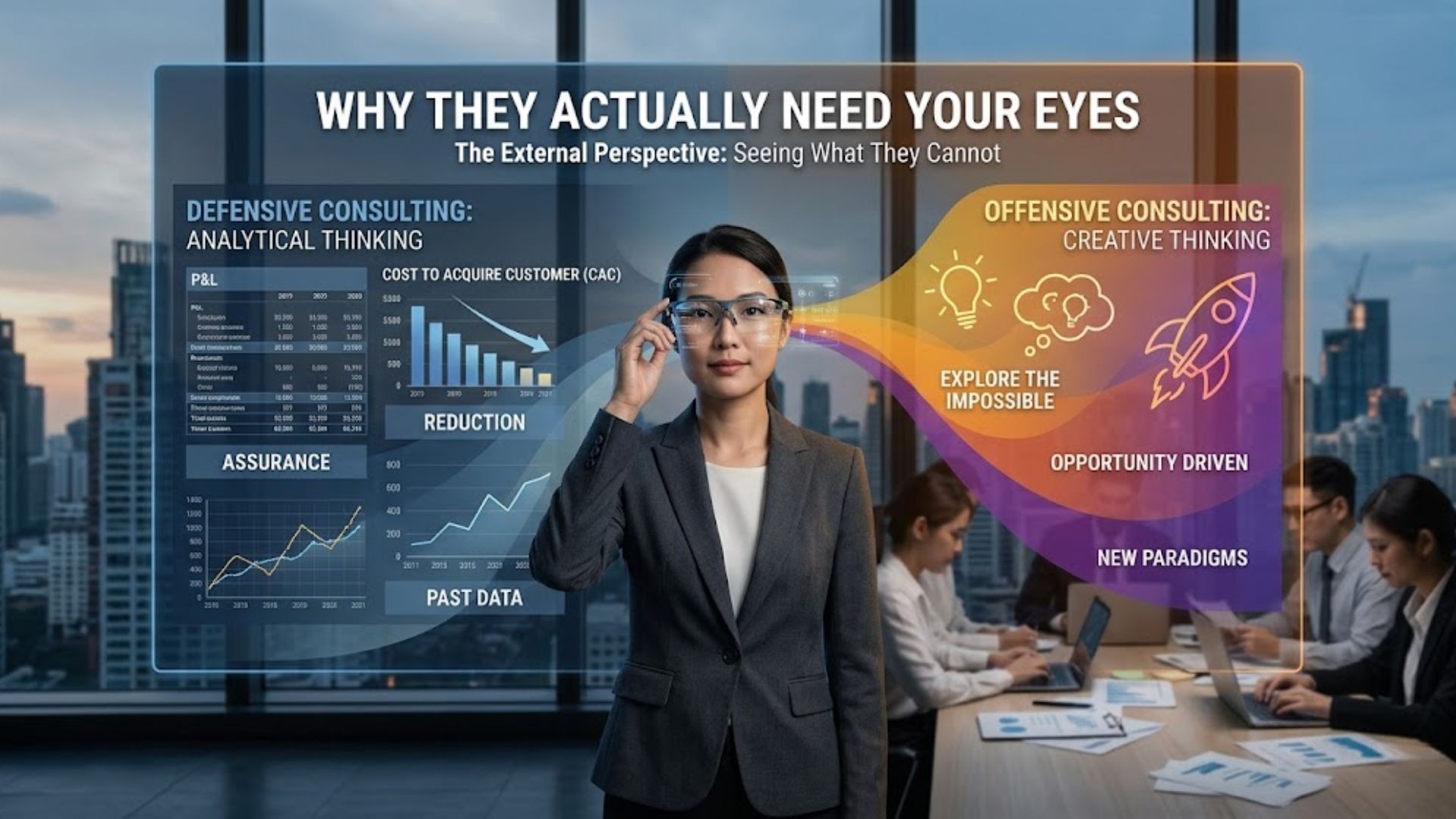
Why They Actually Need Your Eyes
The broader business landscape demands different types of thinking to solve complex problems. Defensive consulting relies heavily on analytical thinking. You base your work on past data, predictive markets, and hard numbers to provide assurance. Offensive consulting leans heavily on creative thinking to explore the art of the impossible.
Both forms of thinking are needed simultaneously within an organisation. When you step in as a consultant, your true value lies in your external perspective and specialist knowledge. You possess the ability to see clearly what those embedded inside the organisation simply cannot see. For example, you might review a profit and loss statement to explore where expenses are unusually high. You look at unit economics like the cost to acquire a customer (CAC) to find operational gaps. You do not replace the internal operations team. Instead, you act as an essential additional piece of strategic help.
Conclusion
Bringing in external expertise is a practice as old as business itself. Becoming a professional consultant allows you to provide an assurance check based on your actual experience and your own intellectual property. Apply this independent consulting framework to maintain your integrity, track your deliverables meticulously, and ensure you operate outside of IR35 with the proper professional insurances.
How will you define your consulting mode before your next big client conversation?
Understand. Reach. Expand.
Peace.
You can access the video here: