The #1 Mistake Professionals Make Before Starting Independent Consulting
Let’s be honest, things feel heavy right now. The pressure to step out on your own and escape the corporate grind is palpable. Over the past few years, I’ve had countless conversations with professionals who want to transition into independent consulting and build a portfolio career.
The questions are always the same: How do I actually secure my first independent consulting contract? How do I position myself properly? How do I move beyond being just an employee? Many professionals are desperate to chase independence, but the reality is that most end up entirely overwhelmed. There is a significant mistake people make before venturing into anything that requires true professional independence.
In this article, I will share exactly what that mistake is and how following the right sequence will keep your exit entirely stress-free.

The Sporadic Quit
The number one reason most people leave their jobs is that someone in that space has made it feel deeply unwelcome.
You might be dealing with a toxic manager, a colleague who is low-key bullying you, or you may have simply outgrown the environment. Out of sheer impatience and a refusal to tolerate the nonsense any longer, quitting becomes a sporadic, emotional reaction.
I have done this myself. I reached a point where I was so fed up with my workplace that I decided to venture out. I was diagnosed as clinically stressed by a GP and had to take at least a month off just to consolidate, rest, and think about my situation. But I was in a different position back then; a sporadic exit doesn’t work for everyone, especially if you have a partner, children, or a mortgage to cater for financially.
Because of this emotional exhaustion, too many professionals treat their current job as a dead end. They fail to see the value their current role provides because they have never been forced to clearly articulate what they are actually doing.
Sequence Reduces Stress
The critical mistake is jumping straight into independent consulting or contracting without a concrete plan. People skip the exact steps that reduce risk and stress.
This happens purely out of impatience. You might look at someone else’s success and become deluded into thinking you can skip steps and just figure it out on the fly. But independence requires an inner discipline to follow things properly, whether that means setting up the right insurances, or speaking to the right people to get your foot in the door of a new industry.
Leaving is not about leaving fast; it is about leaving right. And leaving right is determined by your personal financial situation and what the market actually dictates. Calm and confidence comes from following the right sequence, not skipping steps or chasing shortcuts.
Engineering Your Exit to Independent Consulting
If you want to move beyond being just an employee and build income streams that aren’t tied to one job, you must do the groundwork.
- Audit Your Value First: Use your current role as a launchpad. Be crystal clear about what your role is, the big problems you have solved, and the tangible outputs you have achieved. If you can succinctly articulate these using frameworks like PAR (Problem, Action, Result), the market will be geared towards your services.
- Validate Your Exit: Before you hand in your notice, you must validate market demand. Look at ONS data to see which industries are growing; in the UK, for instance, professional services cater to roughly 80% of growth. Check job boards not to apply for a 9-to-5, but to see what types of advisory or fractional roles organisations are currently demanding.
- Cultivate Real Relationships: We want consulting to be glamorous, but marketing is ultimately just relationship building. I know a freelance consultant who has secured work for two years straight simply through a WhatsApp group filled with CEOs. Stop relying solely on recruiters; learn to speak directly to the economic buyer, the person who actually holds the purse strings.
The Communication Hierarchy
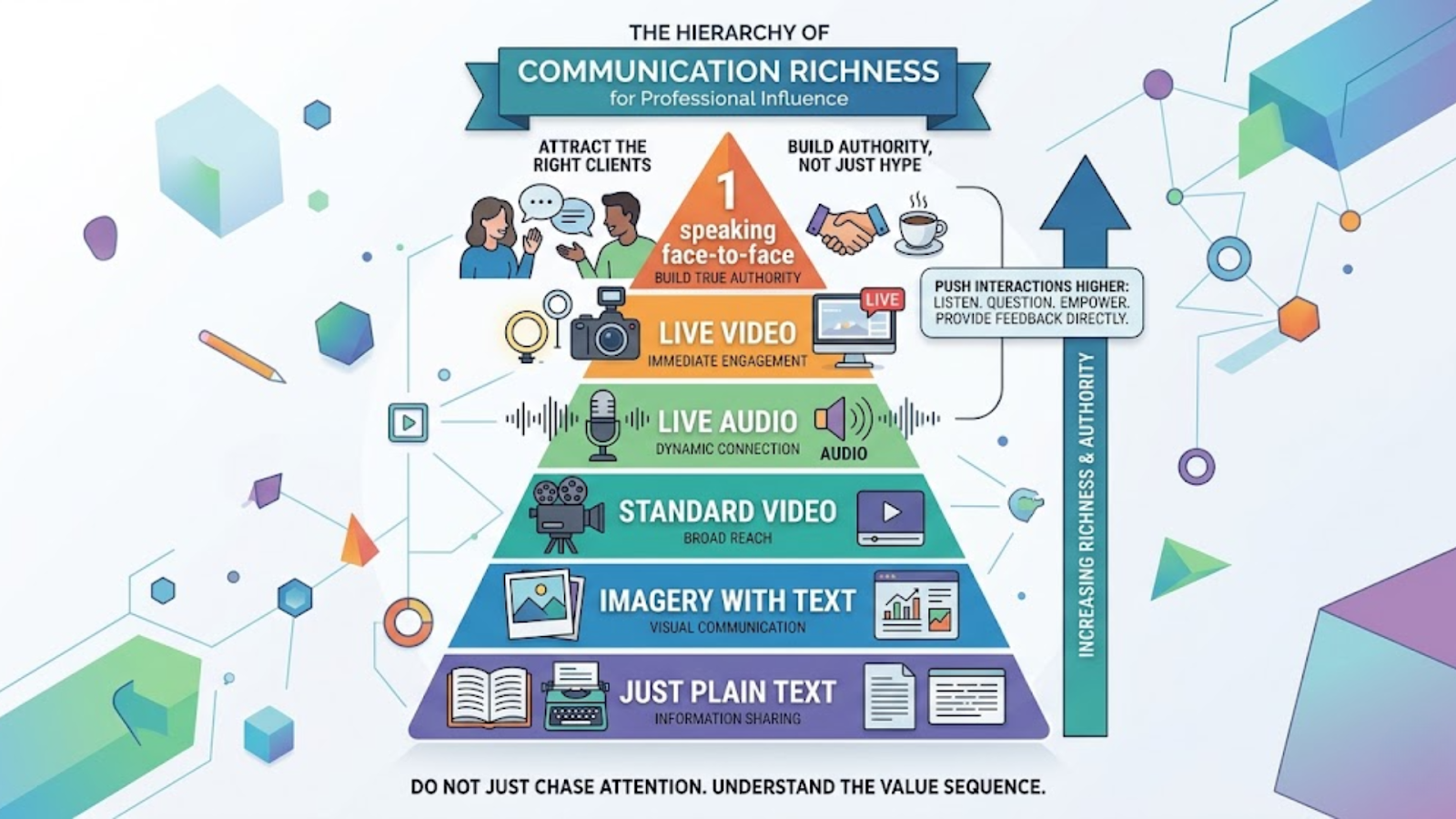
When building a presence that attracts the right clients, do not just chase attention on social media. You need to understand the hierarchy of communication richness.
At the very top of the hierarchy is speaking to people face-to-face. Below that is live video, followed by live audio, standard video, imagery with text, and finally, just plain text at the bottom. If you want to build authority and not just hype, you must push your interactions as high up that hierarchy as you possibly can. You must be willing to listen, question, empower, and provide feedback directly to your target audience.
Conclusion
Do not skip the steps. True independence requires a systematic approach to your own value, your market, and your relationships.
I’m currently considering running something small and focused: a 6-week live sprint for professionals serious about building a successful, profitable independent portfolio consultancy. It will be practical, structured, and completely no-fluff. If you’re interested, confirm your interest here: https://forms.gle/jHVyH1NQfGxuasWZA
How will you create absolute clarity before you make your next career move?
Understand. Reach. Expand.
Peace.
You can access the video here
The #1 Mistake People Make When Leaving Their Job (And How to Do It Right)